SAML 2.0 Overview
1. What is SAML?
Security Assertion Markup Language (SAML) 2.0 is an XML-based standard for exchanging authentication and authorization data between parties.
2. Key Components
| Component | Description |
|---|---|
Identity Provider (IdP) |
Authenticates users and issues SAML assertions. Example: Keycloak, Azure AD, Okta. |
Service Provider (SP) |
Consumes SAML assertions to grant access. Example: Cisco ISE, web applications. |
Assertion |
XML document containing authentication statements, signed by the IdP. |
Metadata |
XML document describing IdP/SP endpoints, certificates, and capabilities. |
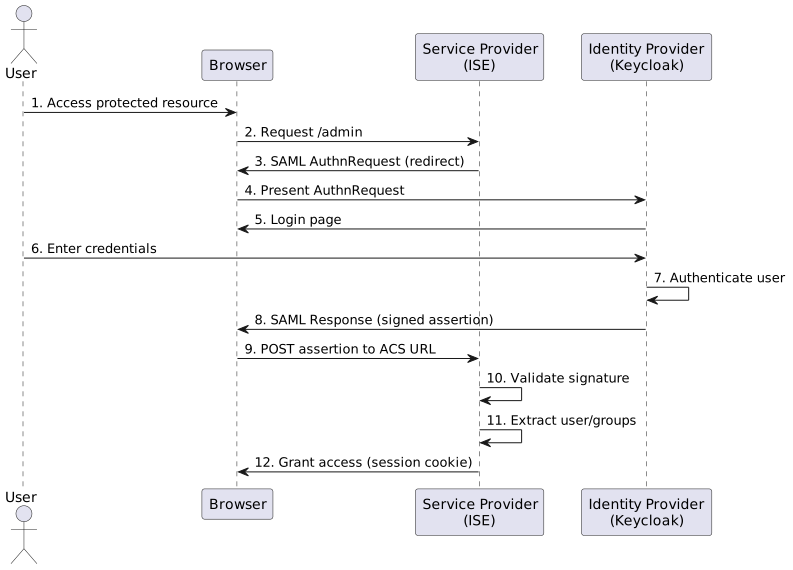
4. SAML Assertion Structure
A SAML assertion contains:
<saml:Assertion>
  <saml:Issuer>https://keycloak.example.com/realms/myrealm</saml:Issuer>

  <saml:Subject>
    <saml:NameID>username</saml:NameID>
  </saml:Subject>

  <saml:Conditions NotBefore="..." NotOnOrAfter="...">
    <saml:AudienceRestriction>
      <saml:Audience>http://CiscoISE/uuid</saml:Audience>
    </saml:AudienceRestriction>
  </saml:Conditions>

  <saml:AuthnStatement>
    <!-- Authentication context -->
  </saml:AuthnStatement>

  <saml:AttributeStatement>
    <saml:Attribute Name="groups">
      <saml:AttributeValue>admin-group</saml:AttributeValue>
    </saml:Attribute>
    <saml:Attribute Name="email">
      <saml:AttributeValue>user@example.com</saml:AttributeValue>
    </saml:Attribute>
  </saml:AttributeStatement>
</saml:Assertion>
5. Key Concepts
5.1. Entity ID
A unique identifier for each SAML participant. Can be a URL or URN.
IdP Entity ID example:
https://keycloak-01.inside.domusdigitalis.dev:8443/realms/domusdigitalisSP Entity ID example (Cisco ISE):
http://CiscoISE/a486c6ef-6c77-4bc1-bf6d-4e479b3aeae8|
Cisco ISE uses a non-standard Entity ID format ( |
5.2. Assertion Consumer Service (ACS)
The SP endpoint that receives SAML assertions from the IdP.
ISE ACS URL:
https://ise-01.inside.domusdigitalis.dev:8443/portal/SSOLoginResponse.action6. Security Considerations
7. SAML vs OIDC
| Aspect | SAML 2.0 | OpenID Connect |
|---|---|---|
Format |
XML |
JSON/JWT |
Transport |
HTTP-Redirect, HTTP-POST |
HTTP-Redirect, JSON APIs |
Use Case |
Enterprise SSO |
Modern web/mobile apps |
Complexity |
Higher |
Lower |
Token Size |
Larger (XML) |
Smaller (JWT) |
When to use SAML: * Legacy enterprise applications (Cisco ISE) * Applications that only support SAML
When to use OIDC: * Modern applications (Gitea, custom apps) * Mobile applications * API access