Graphing Functions Reference
Key Concepts
Domain: All possible input values (\(x\)) for which the function is defined.
Range: All possible output values (\(y\)) the function can produce.
Linear Functions
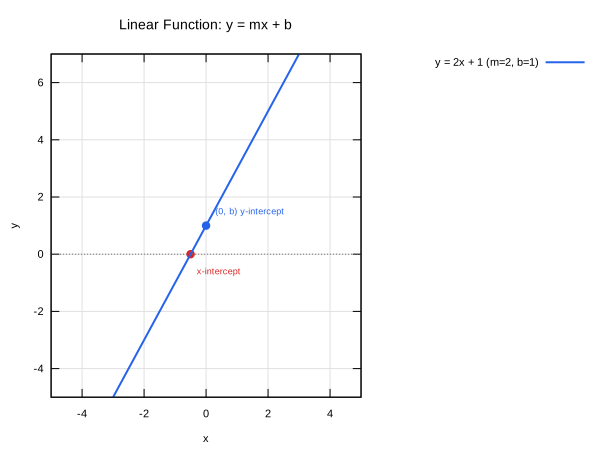
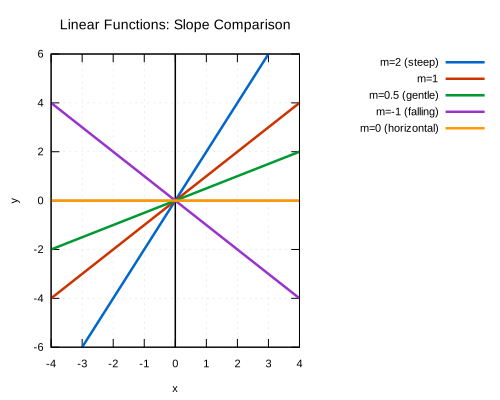
Slope (\(m\)) measures the steepness and direction of a line. It represents the rate of change: rise over run.
Forms
| Form | Formula | Use Case |
|---|---|---|
Slope-Intercept |
\(include::example$math/linear-slope-intercept.adoc[\)] |
When you know slope and y-intercept |
Standard |
\(include::example$math/linear-standard.adoc[\)] |
Finding intercepts |
Point-Slope |
\(include::example$math/linear-point-slope.adoc[\)] |
When you know slope and one point |
Graph Characteristics
-
Shape: Straight line
-
Domain: \((-\infty, \infty)\)
-
Range: \((-\infty, \infty)\)
-
Slope: \(m > 0\) rises, \(m < 0\) falls, \(m = 0\) horizontal
Parallel and Perpendicular Lines
-
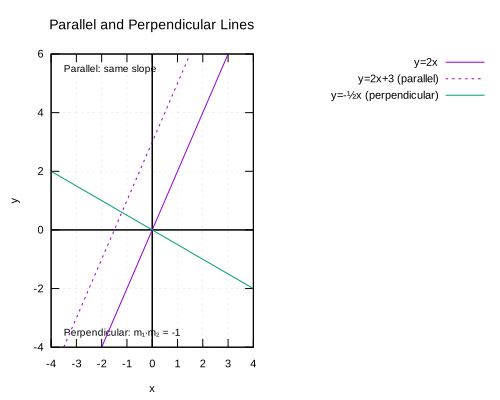
Parallel: Same slope (\(m_1 = m_2\))
-
Perpendicular: Negative reciprocal slopes (\(m_1 \cdot m_2 = -1\))
Quadratic Functions
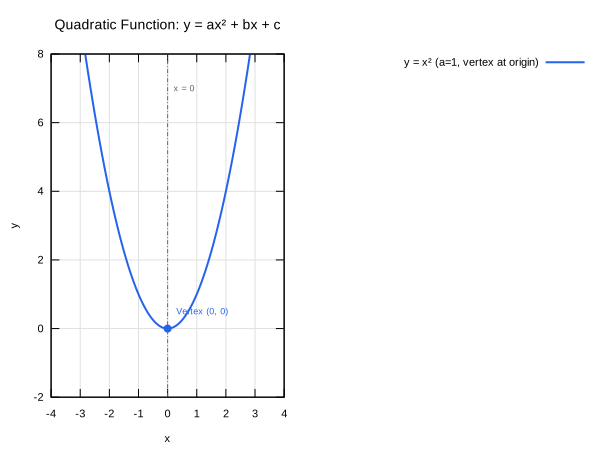
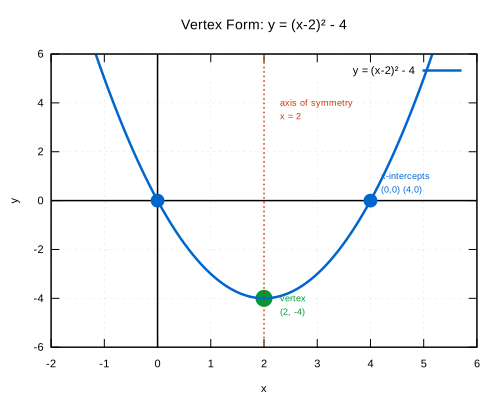
Vertex is the turning point of a parabola. For \(f(x) = ax^2 + bx + c\), the vertex is at:
Forms
| Form | Formula | Use Case |
|---|---|---|
Standard |
\(include::example$math/quadratic-standard.adoc[\)] |
General form, finding y-intercept |
Vertex |
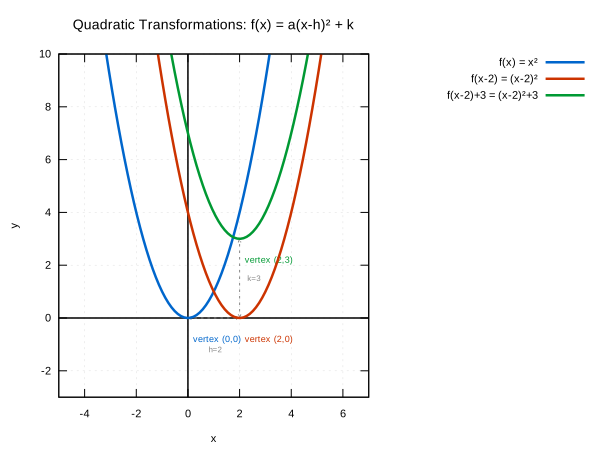
\(include::example$math/quadratic-vertex.adoc[\)] |
When you know the vertex \((h,k)\) |
Quadratic Formula |
\(include::example$math/quadratic-formula.adoc[\)] |
Finding x-intercepts (roots) |
Graph Characteristics
-
Shape: Parabola
-
Domain: \((-\infty, \infty)\)
-
Range: \([k, \infty)\) if \(a > 0\), \((-\infty, k]\) if \(a < 0\)
-
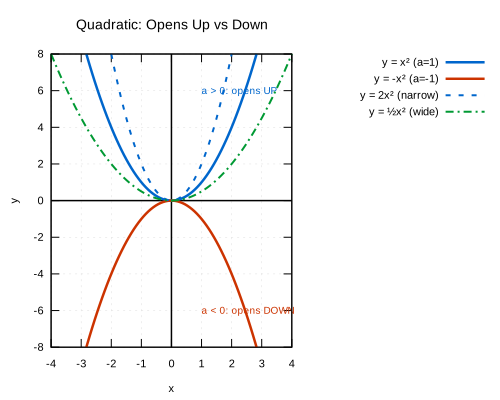
Opens: Up if \(a > 0\), down if \(a < 0\)
-
Axis of symmetry: \(x = -\frac{b}{2a}\)
Polynomial Functions
General Form
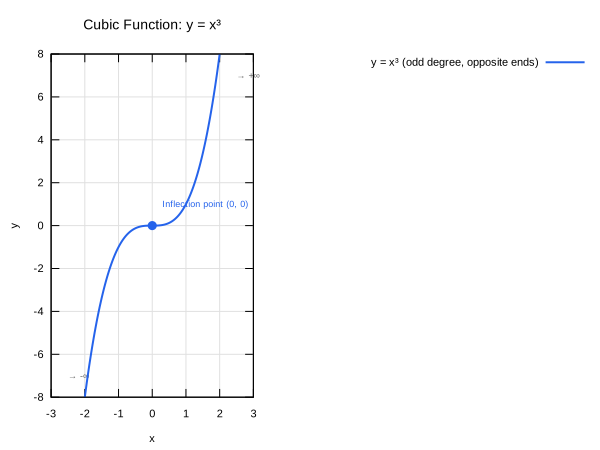
Cubic Function
Graph Characteristics
-
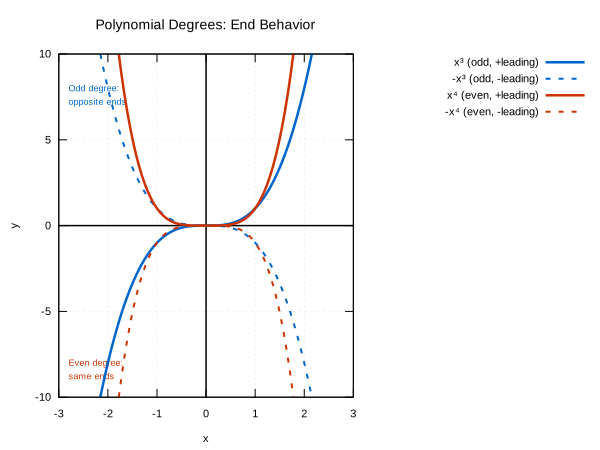
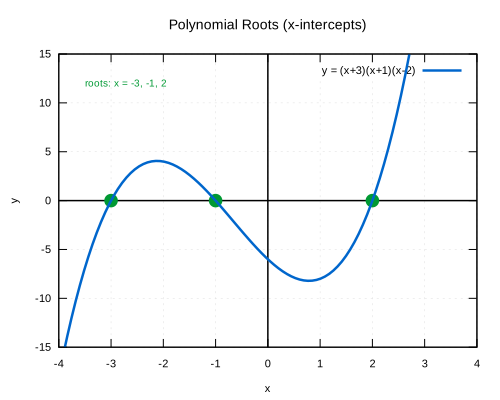
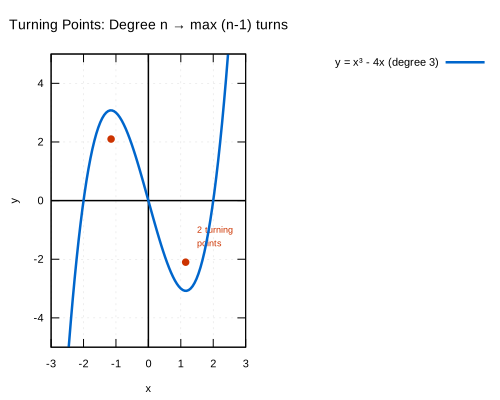
Degree determines end behavior and max turning points
-
Even degree: both ends same direction
-
Odd degree: ends opposite directions
-
Max turning points: \(n - 1\) for degree \(n\)
Exponential Functions
Forms
| Type | Formula |
|---|---|
General |
\(include::example$math/exponential-general.adoc[\)] |
Natural |
\(include::example$math/exponential-natural.adoc[\)] |
Graph Characteristics
-
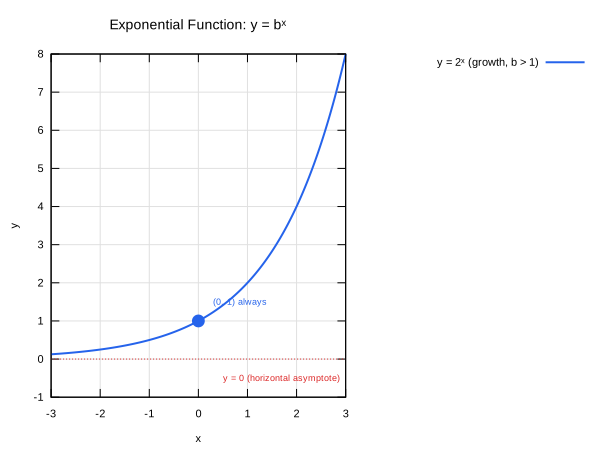
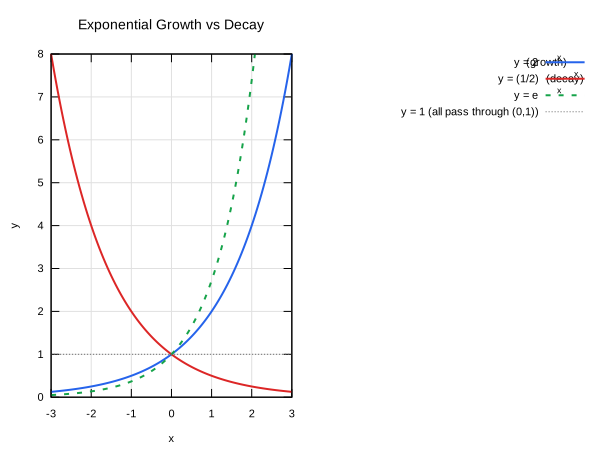
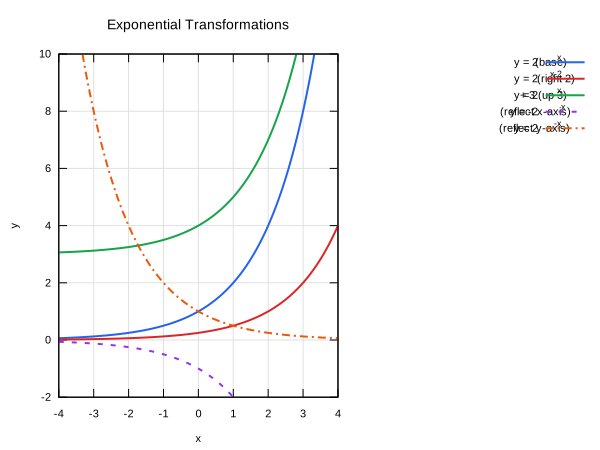
Shape: J-curve
-
Domain: \((-\infty, \infty)\)
-
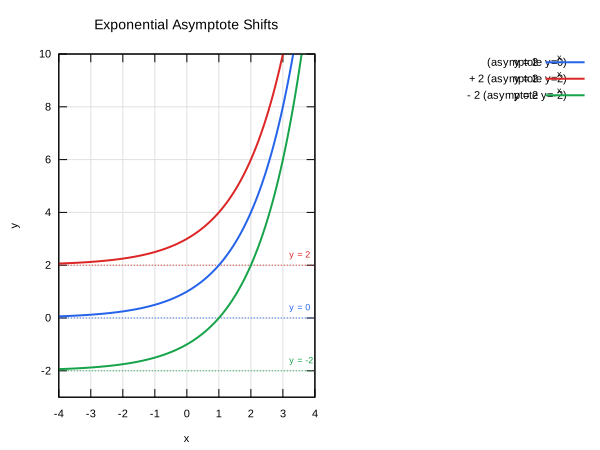
Range: \((0, \infty)\)
-
Horizontal asymptote: \(y = 0\)
-
Growth: \(b > 1\), Decay: \(0 < b < 1\)
Logarithmic Functions
Forms
| Type | Formula |
|---|---|
General |
\(include::example$math/logarithmic-general.adoc[\)] |
Natural |
\(include::example$math/logarithmic-natural.adoc[\)] |
Graph Characteristics
-
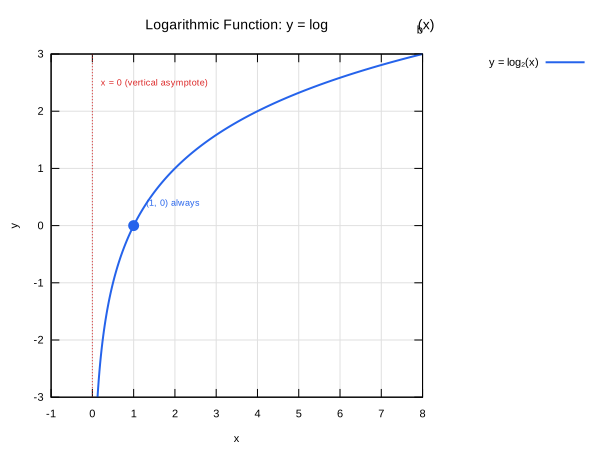
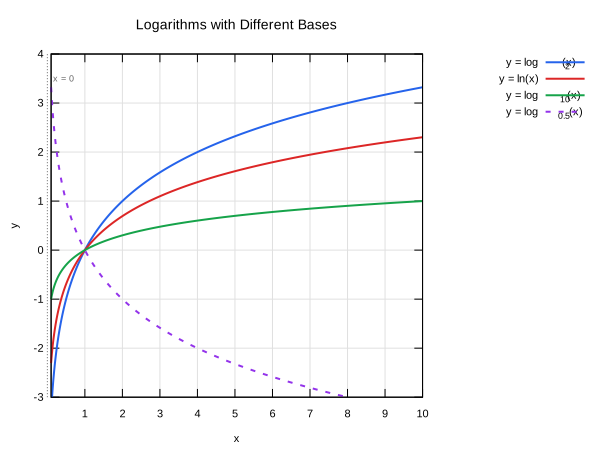
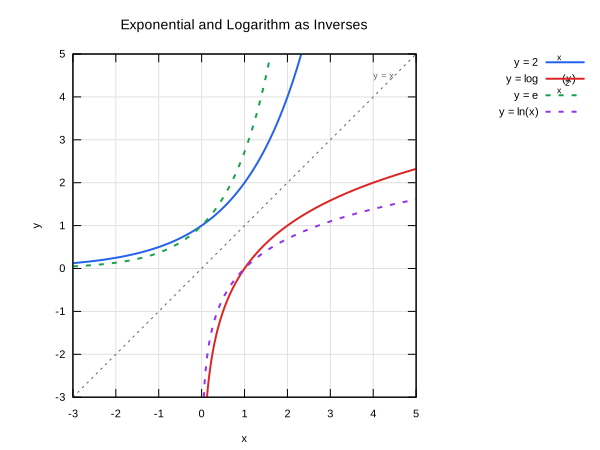
Shape: Inverse of exponential
-
Domain: \((0, \infty)\)
-
Range: \((-\infty, \infty)\)
-
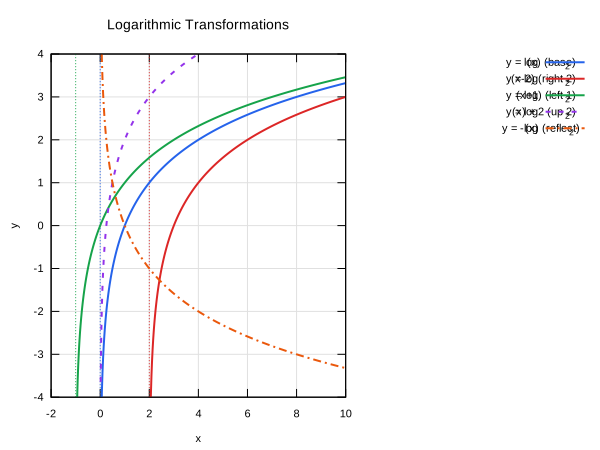
Vertical asymptote: \(x = 0\)
-
Key point: \((1, 0)\) always on graph
Rational Functions
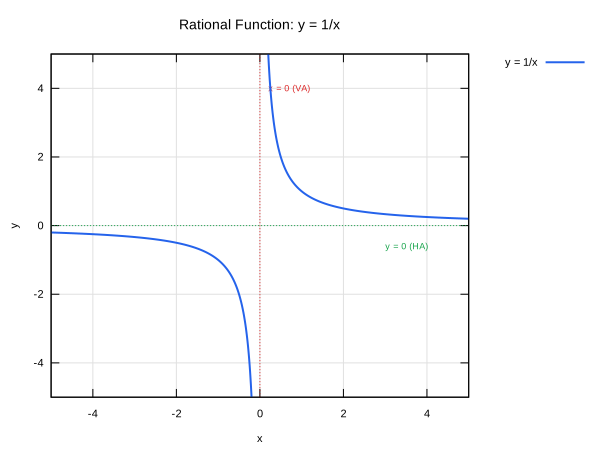
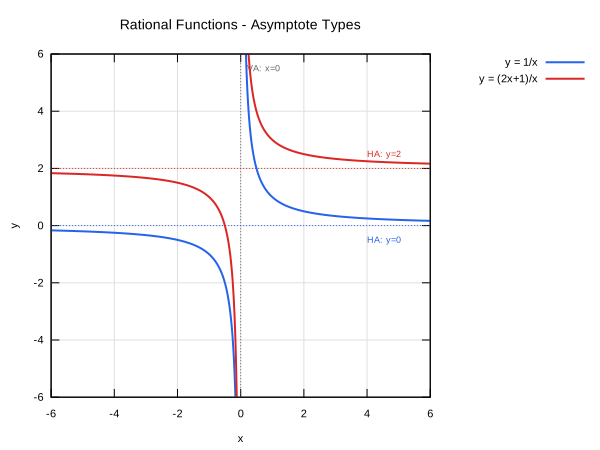
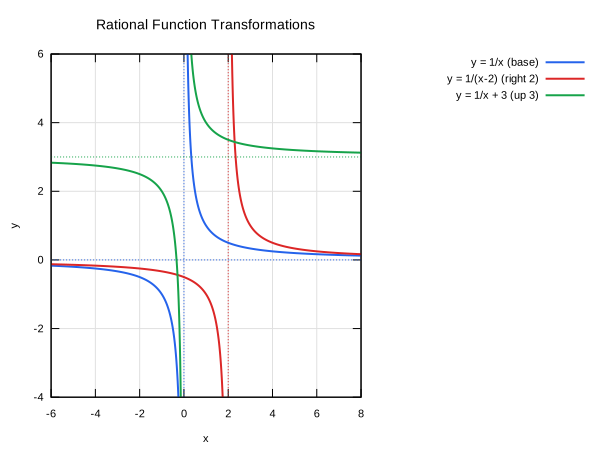
Asymptote is a line that a curve approaches but never touches.
-
Vertical asymptote: \(x = a\) where the function is undefined
-
Horizontal asymptote: \(y = b\) as \(x \to \pm\infty\)
-
Oblique asymptote: diagonal line approached at infinity
General Form
Graph Characteristics
-
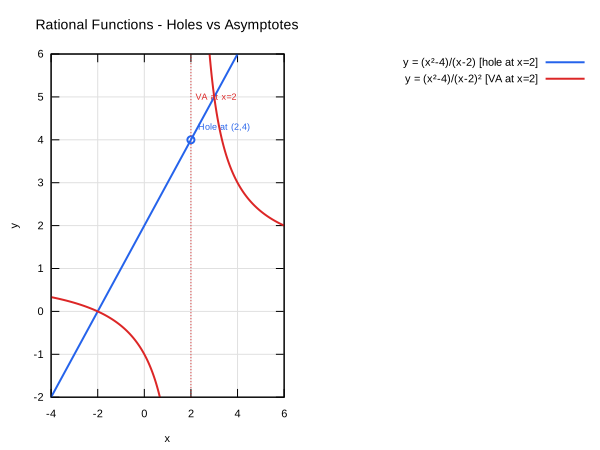
Vertical asymptotes: where \(q(x) = 0\)
-
Horizontal asymptote: compare degrees of \(p(x)\) and \(q(x)\)
-
Holes: common factors in numerator and denominator
Radical Functions
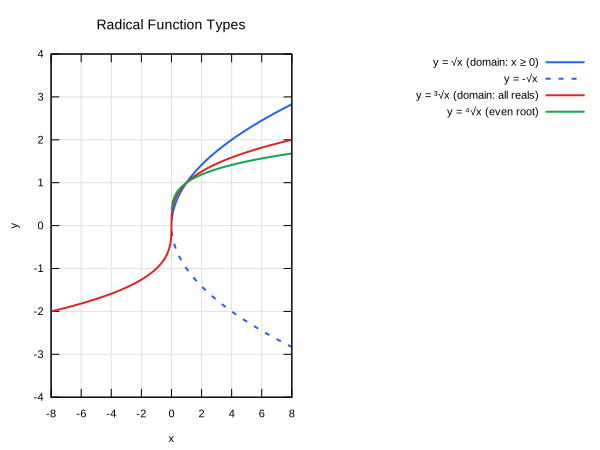
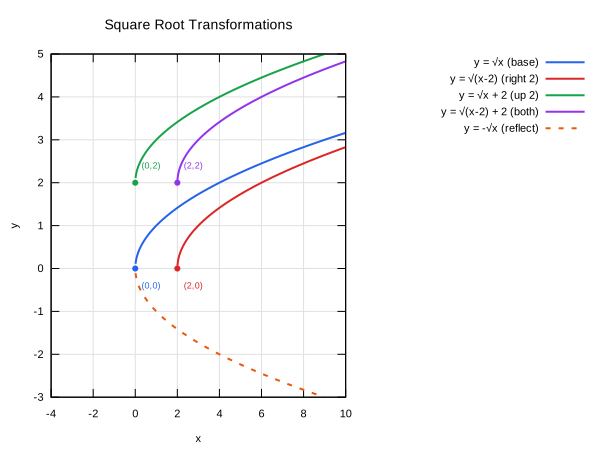
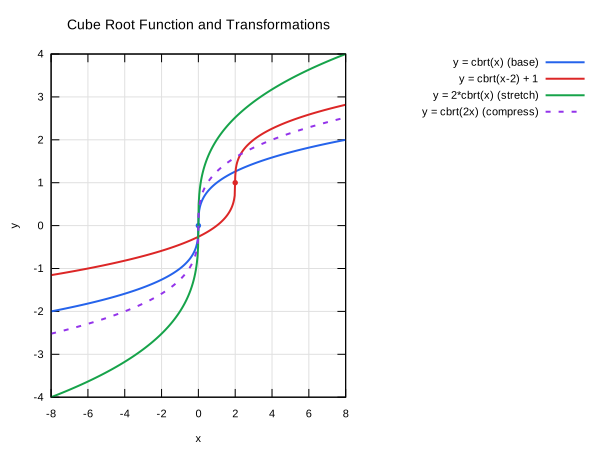
Square Root
Graph Characteristics
-
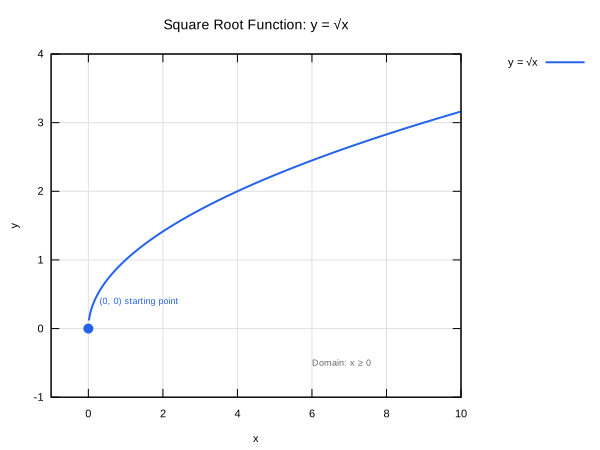
Shape: Half parabola on its side
-
Domain: \([0, \infty)\)
-
Range: \([0, \infty)\)
-
Starting point: \((0, 0)\)
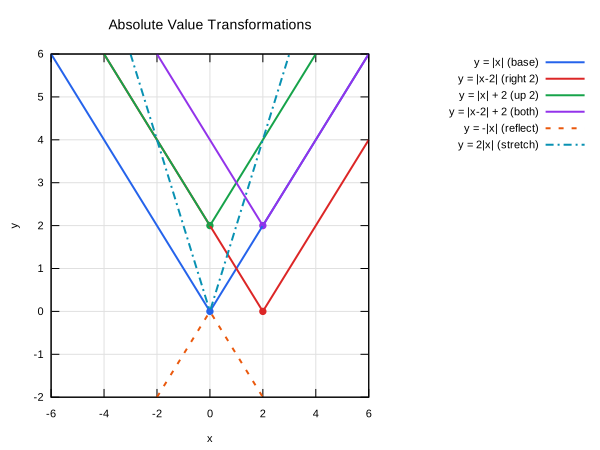
Absolute Value Functions
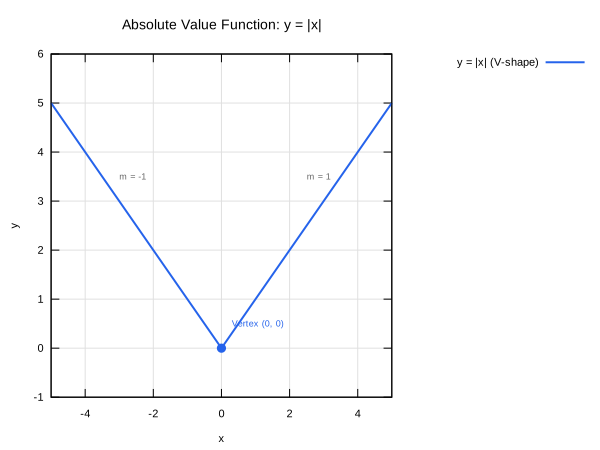
Standard Form
Graph Characteristics
-
Shape: V-shape
-
Domain: \((-\infty, \infty)\)
-
Range: \([0, \infty)\)
-
Vertex: at the point where expression inside equals zero
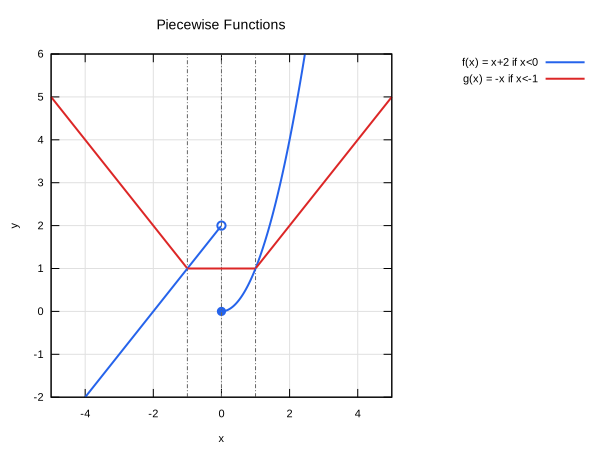
Piecewise Functions
Definition
A piecewise function is defined by different expressions over different intervals.
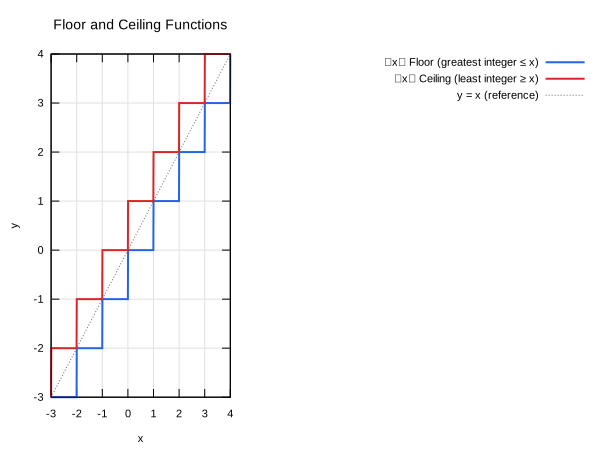
Floor and Ceiling Functions
-
Floor \(\lfloor x \rfloor\): Greatest integer less than or equal to \(x\)
-
Ceiling \(\lceil x \rceil\): Least integer greater than or equal to \(x\)
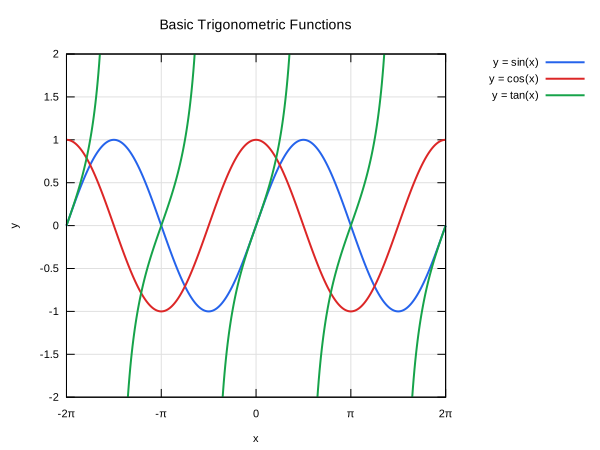
Trigonometric Functions
Sine Transformations
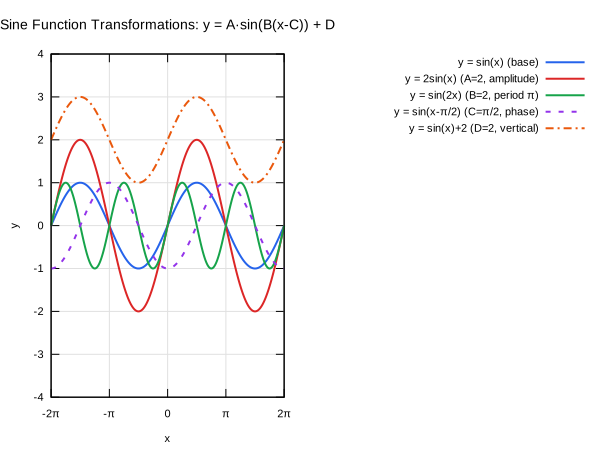
General form: \(y = A\sin(B(x - C)) + D\)
-
A: Amplitude (vertical stretch)
-
B: Affects period (period = \(\frac{2\pi}{|B|}\))
-
C: Phase shift (horizontal)
-
D: Vertical shift
Complex Numbers
Imaginary unit (\(i\)) is defined as:
Complex number: \(z = a + bi\) where \(a\) is the real part and \(b\) is the imaginary part.
Standard Form
Argand Diagram (Complex Plane)
Complex numbers are plotted on a plane where:
-
Horizontal axis: Real part (\(a\))
-
Vertical axis: Imaginary part (\(b\))
The modulus (distance from origin):
The argument (angle from positive real axis):
Quick Reference Table
| Function | General Form | Domain | Range |
|---|---|---|---|
Linear |
\(y = mx + b\) |
\((-\infty, \infty)\) |
\((-\infty, \infty)\) |
Quadratic |
\(y = ax^2 + bx + c\) |
\((-\infty, \infty)\) |
Depends on \(a\) |
Polynomial |
\(a_nx^n + \cdots + a_0\) |
\((-\infty, \infty)\) |
Depends on degree |
Exponential |
\(y = ab^x\) |
\((-\infty, \infty)\) |
\((0, \infty)\) |
Logarithmic |
\(y = \log_b(x)\) |
\((0, \infty)\) |
\((-\infty, \infty)\) |
Rational |
\(y = \frac{p(x)}{q(x)}\) |
\(q(x) \neq 0\) |
Varies |
Square Root |
\(y = \sqrt{x}\) |
\([0, \infty)\) |
\([0, \infty)\) |
Absolute Value |
\(y = |x|\) |
\((-\infty, \infty)\) |
\([0, \infty)\) |
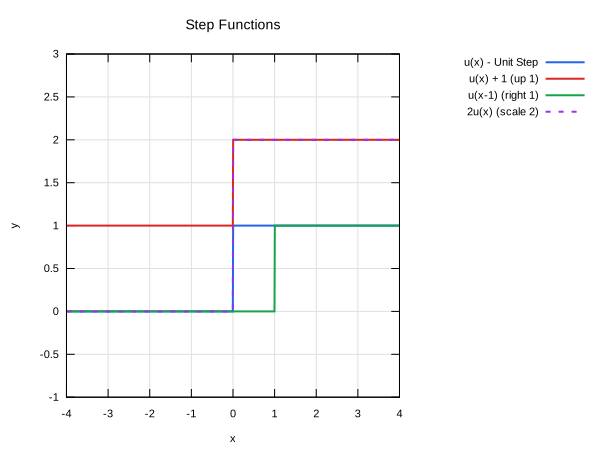
Step (Heaviside) |
\(u(x) = \begin{cases} 0 & x < 0 \\ 1 & x \geq 0 \end{cases}\) |
\((-\infty, \infty)\) |
\(\{0, 1\}\) |
Floor |
\(y = \lfloor x \rfloor\) |
\((-\infty, \infty)\) |
\(\mathbb{Z}\) |
Sine |
\(y = \sin(x)\) |
\((-\infty, \infty)\) |
\([-1, 1]\) |
Cosine |
\(y = \cos(x)\) |
\((-\infty, \infty)\) |
\([-1, 1]\) |
Tangent |
\(y = \tan(x)\) |
\(x \neq \frac{\pi}{2} + n\pi\) |
\((-\infty, \infty)\) |